
Innovation That Drives Performance
Insurance Strategies Designed for the Business of Hospitality

The hospitality industry is undergoing rapid transformation. While evolving guest expectations, tech-driven amenities, and operational expansions unlock exciting growth opportunities, they also fundamentally alter an organization’s risk profile and total cost.
Current market trends highlight why operational evolution requires an adaptive risk strategy:
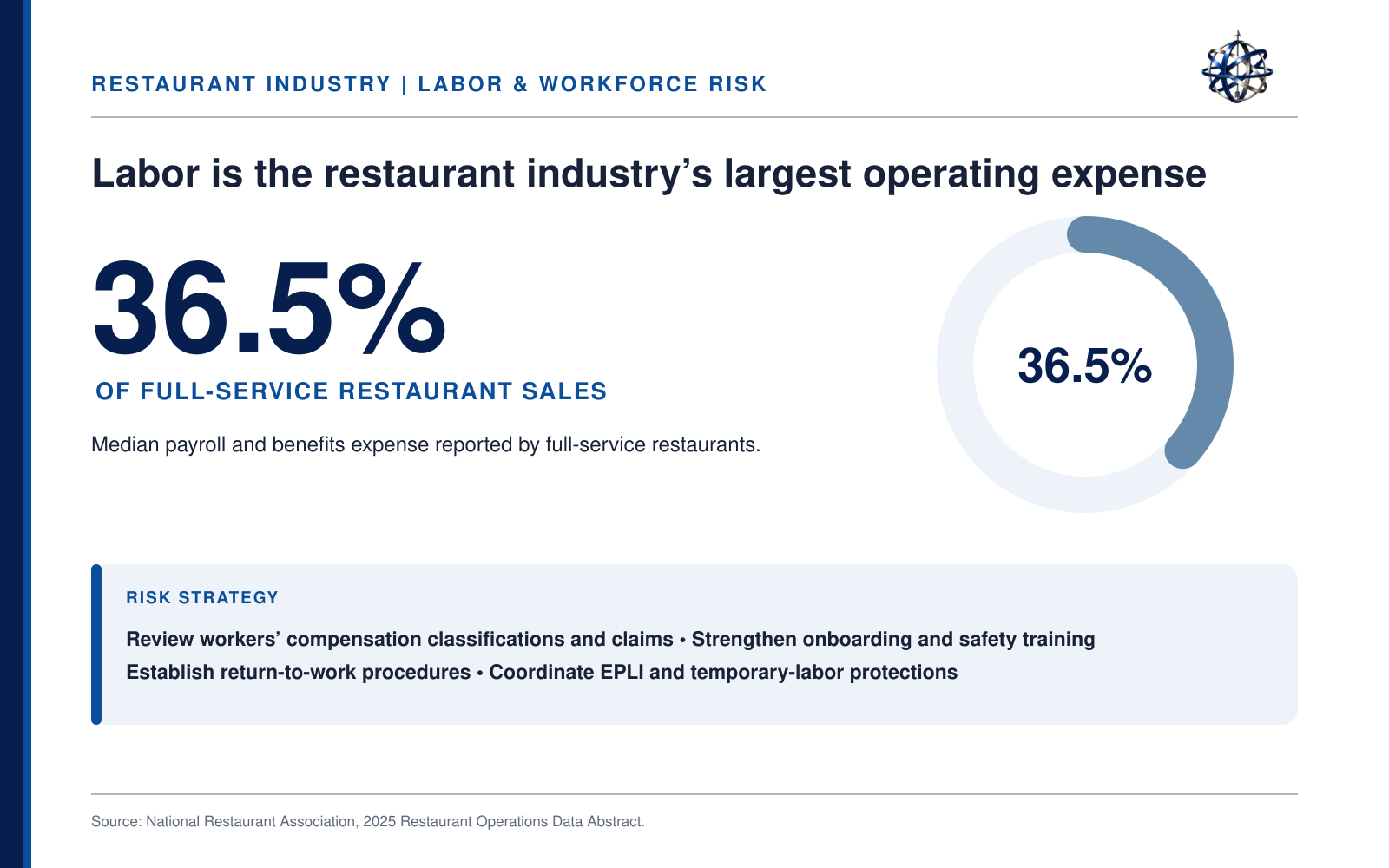
Rising Payroll & Labor Pressures: Wage growth, elevated employee turnover, and evolving employment laws are expanding workers’ compensation and Employment Practices Liability Insurance (EPLI) exposures across the industry.
Technology & Cyber Vulnerabilities: As operators expand digital check-ins, guest mobile apps, and point-of-sale systems, cyber risk has escalated. Data breaches and ransomware represent critical financial threats, making robust cyber liability coverage essential (Source: EHL Insights & HUB International Industry Outlooks).
Severe Weather & Property Valuations: Increasing frequency of climate-driven extreme weather, coupled with inflated replacement and reconstruction costs, is prompting insurers to apply stricter policy terms, higher deductibles, and premium adjustments on commercial property (Source: NCCI & Insurance Market Reports). How your program is marketed and structured matters. Our Team specializing in this field and can drive measurable cost reductions.
Expanded Guest Experiences: Introducing wellness amenities, guided activities, or transport services opens new revenue streams—but directly escalates general, auto, and liquor liability exposures (Source: HUB International).
Venture Commercial Insurance Services helps hotels, resorts, restaurants, and hospitality groups recognize when these operational changes demand a fresh evaluation of coverage, limits, and market strategy.
Insurance That Keeps Pace with Your Operation
Venture Commercial Insurance Services unifies property, general liability, workers’ compensation, cyber, Employment, liability, and excess-market solutions into a single, proactive strategy. For qualified hospitality organizations, we also provide access to alternative-risk and captive programs, subject to underwriting evaluation, historical loss performance, collateral commitments, and long-term risk alignment.
Our role is simple: We analyze how your operation is changing, quantify what those shifts mean for your risk profile, and position your business effectively with underwriters well ahead of your next renewal.
Industry Insurance Trends and Responses
-
As staffing levels and wages increase, workers’ compensation exposure generally increases with them. Employee turnover, seasonal hiring, housekeeping operations, food service, maintenance, and guest transportation can also affect classifications and loss performance.
Growth is an appropriate time to review:
Payroll estimates and workers’ compensation classifications
Experience-modification factors and loss trends
Open claims and outstanding reserves
Return-to-work and employee-safety programs
Employment practices liability limits
Opportunities to approach new carriers or captive markets
We help clients translate operational improvements into a more complete underwriting presentation, giving insurers the information needed to properly evaluate the account.
-
Hospitality organizations increasingly depend on reservation platforms, property-management systems, digital payments, mobile check-in, connected-room technology, and third-party vendors. A disruption or data breach can affect reservations, revenue, guest privacy, and daily operations across multiple properties.
We evaluate cyber coverage for:
Privacy and data-breach response
Ransomware and cyber extortion
Payment-card exposure
Fraud and social engineering
System interruption and lost revenue
Vendor and dependent-system failures
Regulatory investigations and notification expenses
Cyber coverage should reflect the systems a hospitality business actually uses and the financial consequences if those systems become unavailable.
-
Hotels and resorts are especially sensitive to property losses because physical damage can interrupt room revenue, food and beverage operations, events, and other services simultaneously. Rising reconstruction costs and severe-weather activity make current property values and business-income calculations increasingly important.
Our review may include:
Building and contents valuations
Business income and extra expense
Wind, hail, wildfire, earthquake, and flood exposure
Named-storm and percentage deductibles
Ordinance or law and equipment-breakdown coverage
Deductible buy-down and parametric solutions
Portfolio-wide catastrophe concentration
Layered property and excess-market placements
The objective is to ensure the program protects both the physical property and the income the property is expected to generate.
-
Hotels are offering more than accommodations. Restaurants, bars, spas, fitness programs, conferences, entertainment, valet services, shuttles, and special events can each introduce exposures that may not be fully addressed by a standard hospitality policy.
We evaluate general liability, liquor liability, commercial auto, hired and non-owned auto, professional liability, abuse and molestation, event cancellation, and umbrella or excess liability coverage as appropriate to the operation.
When services, amenities, locations, or revenue change, it is an appropriate time to review the insurance program and determine whether the current structure still reflects the business.
-
Proven Financial & Operational Impact
An active claims advocacy process yields measurable financial returns across key metrics:
25% to 35% Reduction in Total Claim Costs: Employers utilizing structured Return-to-Work advocacy routinely lower overall claim costs by keeping claims in lower-severity categories.
50%+ Reduction in Lost Workdays: According to studies by the RAND Institute, proactive return-to-work programs shorten the average length of an injured employee's absence by 3.6 to 12.6 weeks.
Substantial X-Mod Savings: Because lost-wage (Indemnity) claims impact the Experience Modification calculation significantly more than Medical-Only claims, eliminating lost time directly prevents multi-year premium increases.
Litigation Suppression: Upwards of 80% of workers' comp attorney representation occurs simply because an employee feels ignored or confused. Direct, compassionate advocacy keeps claims out of litigation, saving tens of thousands in legal defense fees and inflated settlements.
Request a Tailored Coverage Consultation
Tell us about your challenges, timeline, and goals, and our team will get back to you with practical recommendations.